|
 |
|
|
 |
|
| The Reform Era |
|
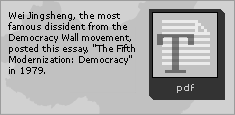
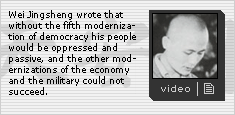
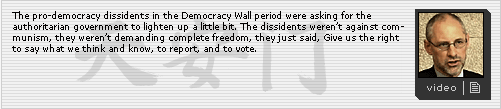
| Mao Zedong died in September 1976. After that China entered the era of reform that has continued for the past 25 years. At the beginning of the reform era, a famous episode called "Democracy Wall" took place in late 1978 to early 1979. It was not the first instance of dissent in modern China but it was the most spectacular one up to that time. People put up wall posters, mimeographed writings, and mimeographed periodicals—Chinese-style underground periodicals, or samizdat, as they were called in Russia. |
|
| Wei Jingsheng |
|
 |
|
|
|
|
| Democracy Wall |
|
 |
|
| Political Reform |
|
| Even after the crackdown, leaders of the regime itself began to discuss what they called political reform. They used the phrase socialist democracy, but nobody knew quite what it meant. Political reform is a term that emerged a couple of years after Democracy Wall and came to be used by China's Communist Party. In 1980, Deng Xiaoping, the dominant leader of China throughout the reform period until his death in 1997, gave a secret talk inside the Party. It leaked to the West. He argued that the Communist Party had to reform the way it related to the governmental units, what was called the "state." He said that the Party was controlling everything too closely, that it needed to step back as a party and let the courts, the legislature, the media—all of which are part of the state—do their jobs. Deng's vision of democracy involved tapping into the dynamism of society so that state and society could work together. |
|
| Economic Reform |
|
| Deng proposed this idea in 1980, and from 1980 to 1989 discussion continued about how to enact political reform. By 1989, though, no political reforms had been made. The regime had been busy with other issues. It was a tough decade for the Chinese leaders. They hit a stone wall when they tried to fiddle with the economic system. They experienced high inflation, and corruption became a serious problem, so they never really got to the agenda of political reform. It was against this background that in April 1989 students began to ask about political reform. |
|
|
 |
|
|